
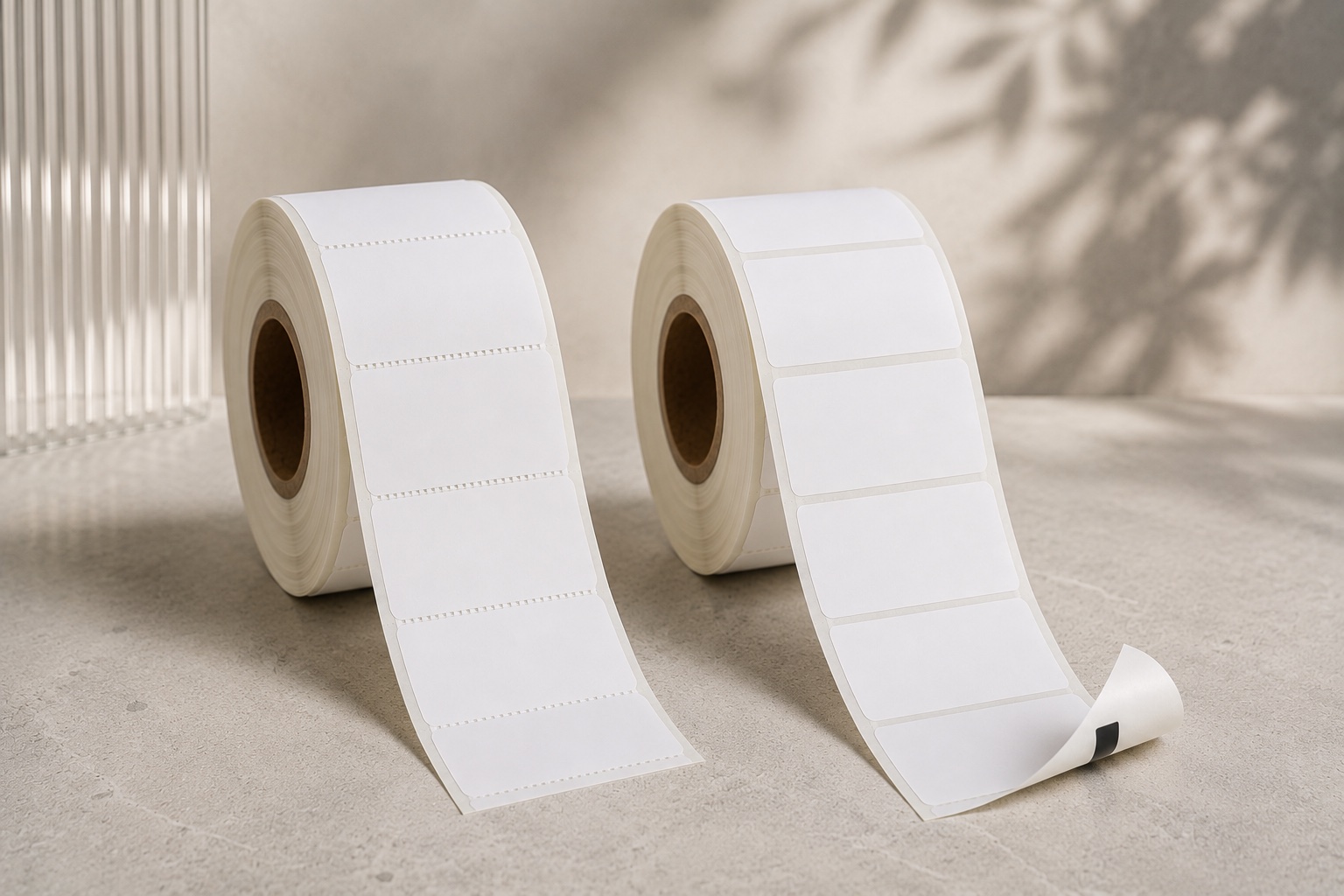
When a roll of perfectly good labels misprints — text drifting up the label, one blank label between every print — the material is rarely the problem. The printer simply can't tell where one label ends and the next begins. That's what these three small spec lines are for.
Gap
The standard case. Labels are separated by a few millimetres of bare liner, and the printer's transmissive sensor shines light through the web: more light gets through at the gap, and that's the registration signal. A 3 mm gap is the common default. Gap sensing needs a liner the sensor can see through — which is exactly what fails with opaque or very dense materials, and that's when you move to a black mark.
Black mark
A printed black bar on the back of the liner, read by a reflective sensor. It works regardless of what the face material lets through, which makes it the right choice for blockout stock, dark or metallised faces, continuous media cut to length, and irregular die-cuts where the gap isn't a clean straight line. The mark's position and width have to match what your printer expects — that's why we ask for the printer model, not just "with black mark".
Perforation
A row of fine cuts across the liner (and sometimes the face) between labels. It isn't a sensing method — it's a tear-off aid: receipts, tickets, and any application where an operator tears off one label or one set at a time. Perforation combines freely with gap or black-mark sensing; you specify it on top, not instead.
The rule of thumb
- Standard die-cut labels on a translucent liner → gap.
- Opaque, dark or continuous material, or irregular shapes → black mark.
- Hand-torn at the point of use → add a perforation.
Tell us your printer model and we'll set the gap, mark and perforation to match it — along with core size, roll diameter and winding direction. The details live on the rolls & formats page.
Facing this on a live job? Tell us the surface, the conditions and the press — we'll match a construction and price it within 1–2 business days.
Get a price