
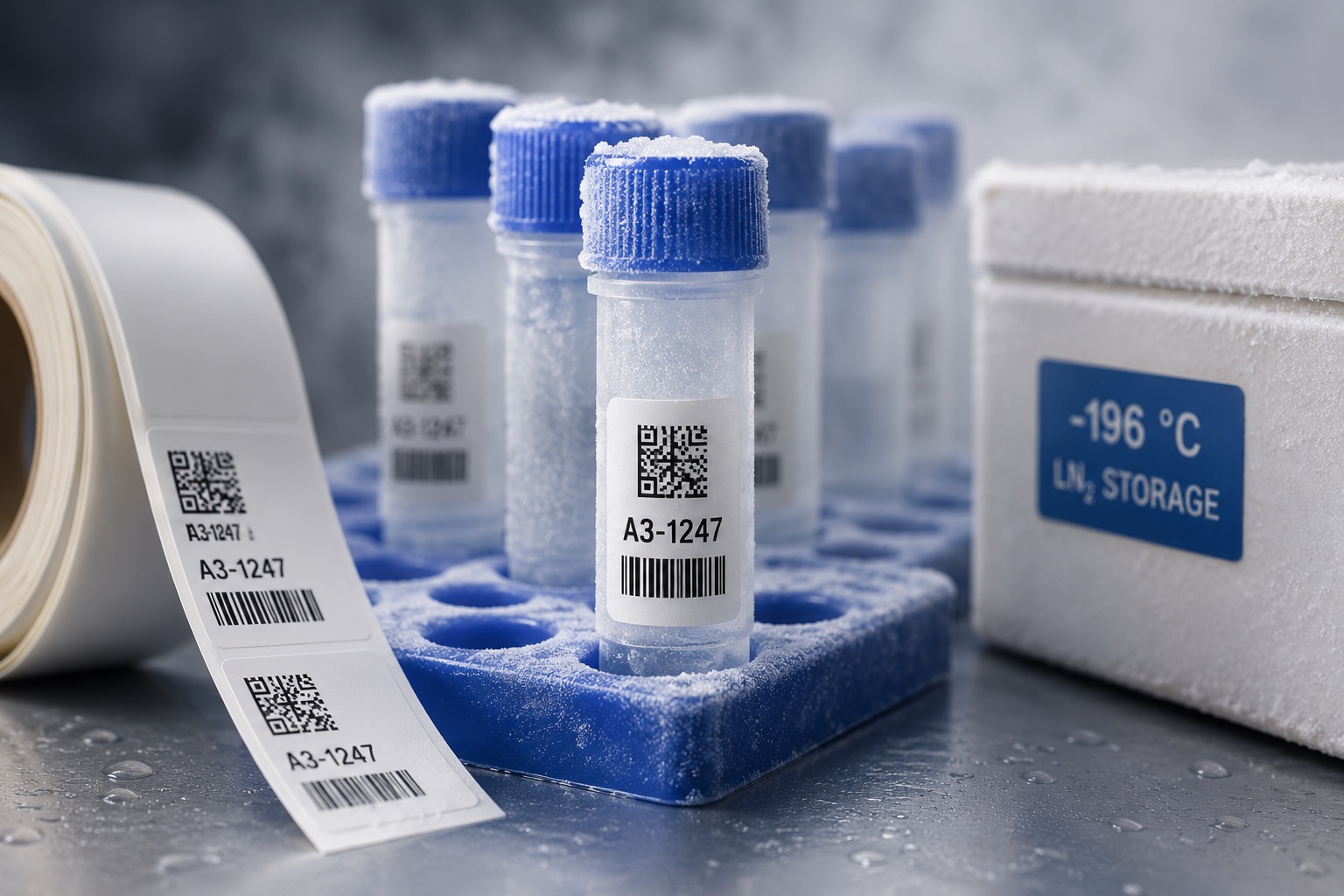
Most permanent adhesives are specified down to about −20 °C — comfortably enough for a household freezer, and nowhere near enough for a biobank. Below its glass transition temperature, a standard acrylic adhesive stops behaving like a soft, tacky film and starts behaving like glass: hard, brittle, and holding onto nothing. The label doesn't peel — it flakes off in one piece, usually somewhere between the freezer and the point where someone needed to read it.
Application temperature is not service temperature
The two numbers on an adhesive datasheet that matter here are often confused. Minimum application temperature is the coldest the surface may be at the moment of labelling — the adhesive needs enough mobility to wet out and build a bond. Service temperature range is what the bond survives once it has formed. A typical deep-freeze adhesive might apply down to −5 °C but hold down to −60 °C; the bond forms warm and rides the temperature down.
That order of operations is the single most useful trick in cold-chain labelling: whenever the process allows it, label at room temperature, then freeze. A bond formed at +20 °C and cooled slowly will outperform the same adhesive applied onto an already-frosted surface every time.
What actually holds at cryogenic temperatures
For true cryogenic work — vapour-phase liquid nitrogen storage at −150 °C to −196 °C, dry ice at −78 °C — the construction changes in three places at once:
- The adhesive is a dedicated cryo formulation, usually a modified acrylic that keeps enough elasticity below its glass transition not to shear off when the substrate contracts.
- The face material is film, not paper. Paper takes on moisture, and moisture at −180 °C means frost, curl and delamination. PP or PET faces stay dimensionally stable and keep thermal-transfer print legible.
- The print method matters: resin-ribbon thermal transfer survives liquid nitrogen and the alcohol wipe-downs that usually follow; direct thermal does not.
Three practical rules
- Label dry, label warm — condensation on a tube or tray is the most common cause of cryo label failure, ahead of the adhesive itself.
- Give the bond dwell time: 24 hours at ambient before freezing is ideal for small-radius surfaces like vials, where the adhesive is fighting the curl of the face material.
- Test the whole cycle, not just the cold: freeze, thaw, condensation, refreeze. Repeated cycling kills more labels than the minimum temperature does.
We stock cryo-rated constructions in the common vial and cassette formats, and we can match one to your surface and storage regime — see adhesives and film labels for the building blocks.
Facing this on a live job? Tell us the surface, the conditions and the press — we'll match a construction and price it within 1–2 business days.
Send us an inquiry